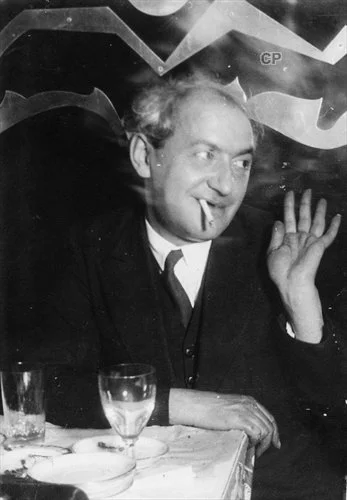
Jules Pascin
Julius Mordecai Pincas was born in on the 31. March in Vidin, Bulgaria. At the request of his father, who did not accept his artistic vocation, he henceforth signed himself "Pascin," an anagram of Pincas.
He always worked "from life," drawing in the cafés and brothels he frequented. What interested him were people, their expressions, their gestures; he observed and drew with rapid strokes, without second thoughts.
Biography
Julius Mordecai Pincas was born on March 31, 1885, in Vidin, Bulgaria, and died on June 2, 1930, in Paris.
He was one of the leaders of the "School of Paris."
He was the seventh child of Marcus Pincas, a wealthy grain merchant, and Sophie Russo, both Sephardic Jews.
In 1892, the Pincas family moved to Bucharest, Romania.
Julius Mordecai Pincas left at the age of 17 to pursue art studies in Vienna. In 1904, he arrived in Munich, attended the Mortiz Heymann Art School, and contributed to the satirical magazine "Simplicissimus," founded by Albert Langen, who offered him a contract for 400 marks per month.
This contract allowed him to live comfortably for many years, and he continued to send his drawings to the newspaper until 1921.
At the request of his father, who did not accept his artistic vocation, he henceforth signed himself "Pascin," an anagram of Pincas.
After a brief stay in Berlin, he arrived in Paris on December 24, 1905, where he was already known to the painters who frequented the Café du Dôme, known as the "Dômiers," who gave him a warm welcome. Among them were William Howard, Rudolf Grossmann, Emil Orlik, and Walter Bondy.
He settled in Montparnasse, rented studios, frequented cafés, and became friends with artists and writers. In 1907, he met Hermine David, a painter and miniaturist. She would become his companion; he married her in 1918 in the United States.
He held his first solo exhibition at Paul Cassirer's in Berlin, and another at Berthe Weill's in 1910. He exhibited regularly at the Salons d'Automne and des Indépendants.
He always worked "from life," drawing in the cafés and brothels he frequented. What interested him were people, their expressions, their gestures; he observed and drew with rapid strokes, without second thoughts.
He followed no fashion, no school. His art was entirely personal.
He met Lucy, a model at the Académie Matisse, who would become his lover and for whom he experienced a passion that would lead to suicide.
In 1911, he exhibited at the Berlin Secession, where he was introduced among the Expressionist painters.
In 1913, he exhibited at the New York Armory Show and was a great success. Lawyer and art lover John Quinn purchased several of his works.
To avoid being drafted into the Bulgarian army, he left Paris for America in 1914, via London, and did not return to France until 1920, at the end of the war.
He settled in New York and frequented the Penguin Club founded by Walt Kuhn, where he met Max Weber and Maurice Sterne, former "Dômiers."
Hermine David joined him in New York in 1915. They spent every winter in the southern United States, especially Cuba.
During his travels, particularly in the southern United States, his palette changed; he abandoned cold, dark tones and black-rimmed drawings for violent, vivid, and warm colors. His surroundings were no longer the same; he was interested in landscapes and nature. He lived among the most humble peasants and shared their daily lives.
It was there that he experimented with Cubism, but deconstruction didn't interest him, and he quickly abandoned it.
In 1918, he married Hermine David and acquired American citizenship in 1920.
Upon his return to Paris, he settled in Montmartre, but every evening he joined his friends in Montparnasse. After years of war and deprivation, everyone wanted to have fun; these were the famous "Roaring Twenties."
He saw Lucy again, who, in the meantime, had married a Norwegian painter, Per Krohg, with whom she had a son, Guy. Their stormy and hopeless affair resumed.
In 1921, he returned to Tunisia with Hermine, invited by the Tunisian painter Abdul Wahab, whom he had met in Montparnasse. He had already been there in 1908 and would return in 1924, without Hermine, who had remained close to him, but Lucy had replaced her in his heart.
In 1922, Dr. Barnes came to Paris to purchase his works.
Pascin regularly participated in the exhibitions of La Licorne organized by Berthe Weill.
In 1923, he moved to 36 Boulevard de Clichy in Paris, where he resided until his death.
After years of research, Pascin developed a technique of painting with essence, applied very lightly on a thin canvas. The pastel-like tones create an airy, vaporous effect, with the flesh-colored skin the color of mother-of-pearl, giving the painting a very sensual appearance. Critics called it "the pearly period."
The Pierre Gallery opened its doors in 1924, and Pascin presented his works at the opening of the gallery's first exhibition.
He met André Warnod in 1925, and they became very close.
He organized large parties every Saturday evening in his studio, where all the models, writers, and artists were invited to enjoy themselves and share gargantuan buffets. His generosity was legendary.
Pascin traveled extensively in the south of France.